
Hydraulic Cylinder Welding
Welding is an important production step of hydraulic cylinders. It applies to most types of cylinders except tie-rod cylinders which are connected using 4 tie-rods and bolts.
Welding Steps
The welding process has five steps: bevel cleaning and preheating, submerged arc welding or gas shielded welding, post-weld slag removal and grinding, post-weld heat treatment, and weld non-destructive testing. These steps cover welding for cylinder barrels to cylinder bottoms, oil port bosses, and lugs.We machine bevels in advance at the joints: cylinder barrel and cylinder bottom, oil port bosses, lugs. These prepared bevel areas are our welding zones.
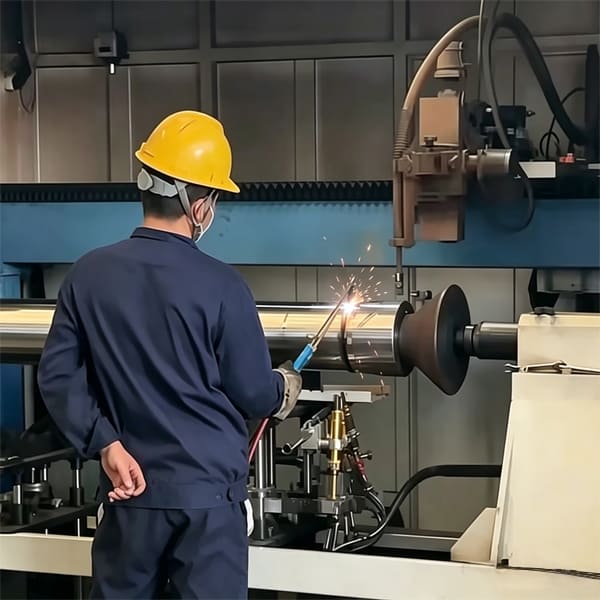
1. Bevel Cleaning and Preheating
The first step in welding is bevel cleaning and preheating. We prefer to machine bevels by turning and milling. If we form the bevel by flame or plasma cutting, we must grind away the oxide and hardened layers on the bevel face.
Also, we clean the area within 20 mm on both sides of the bevel down to bare metal. No oil, rust, moisture or weld spatter can stay on the surface. Once cleaning is finished, we must preheat the weld zone for thick-wall high-pressure or marine cylinders. This lowers the cooling rate after welding. It prevents the steel from becoming brittle due to rapid cooling and avoids cold cracks in the weld.
We set preheat temperatures according to steel type. For example, 27SiMn runs at 200~300℃, while we keep Grade 45 steel and 40Cr at 150~200℃.
2. Submerged Arc Welding or Gas Shielded Welding
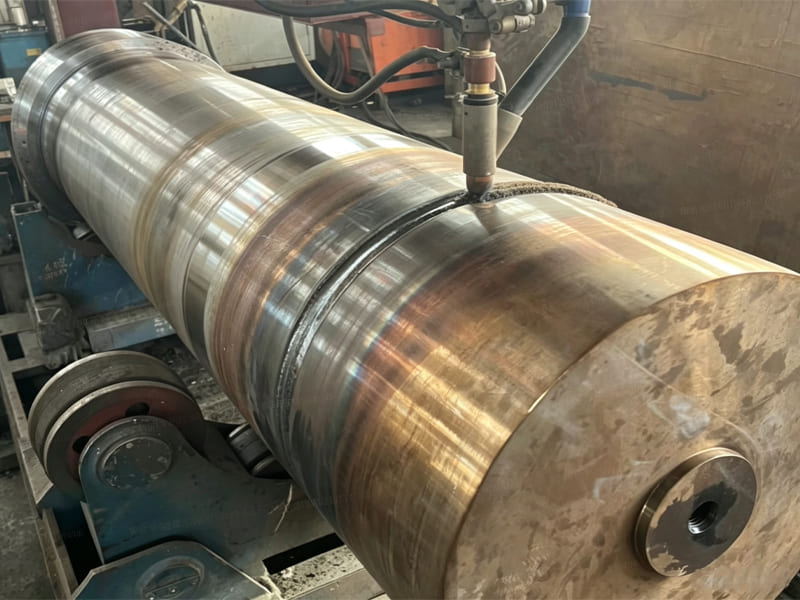
The second step is welding. We use submerged arc welding or gas shielded welding. For the root pass, we use TIG welding or GMAW. We can fine-tune the current with these two welding methods. We get a stable arc and can easily manage heat input. This guarantees full penetration at the weld root.
Once we finish the root pass, we do the fill and cap passes. We stick with dual-pulse gas shielded welding or submerged arc welding for these layers. We never change welding methods midway, so weld quality stays consistent. When welding the cylinder barrel’s circumferential seam, we adopt symmetrical skip welding. That means we weld in segmented, symmetrical or staggered sections. This spreads welding heat evenly and stops the barrel from distorting after welding.
We clear slag after every layer and wait for the weld to cool to the required interpass temperature before starting the next run. If interpass temperature gets too high, the steel’s internal grain becomes coarse and toughness falls, making the weld brittle. If it is too low, cold cracks can form.For oil port boss welding, the weld only fixes it for positioning. Sealing comes from mechanical locking structures. We run low welding current here to reduce heat effect on the cylinder barrel’s inner wall.
When we weld lugs to the cylinder barrel using dissimilar metals, cracks can easily occur for the 27SiMn and Grade 45 steel combination. So we limit the share of melted 27SiMn mixed into weld metal to 20%-30%. 27SiMn is high-strength steel. If too much of it melts into the weld, the weld will get harder and lose toughness. When weld toughness drops, cooling shrinkage creates internal stress, and the brittle weld may crack. This control reduces the chance of weld cracking.
3. Post-Weld Slag Removal and Grinding
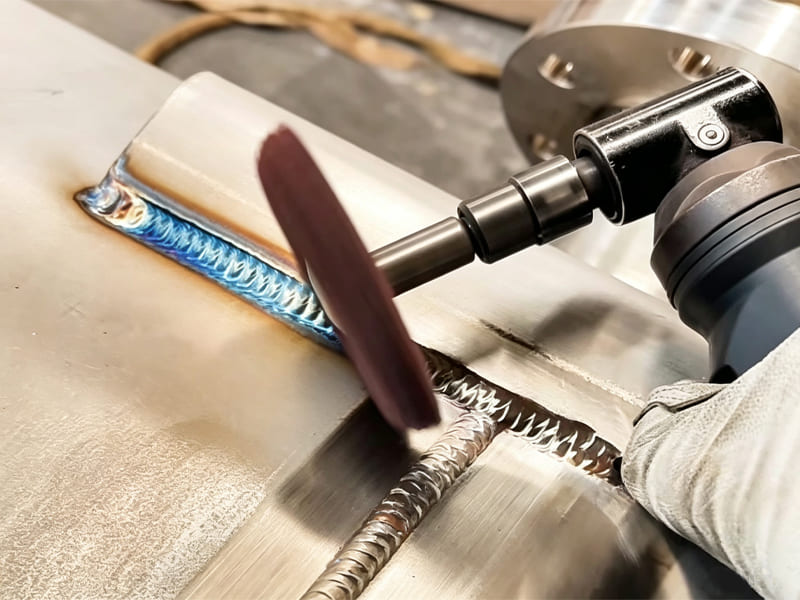
The third step is post-weld slag removal and grinding. During welding, we clean slag and spatter after every weld run. When we do multi-layer and multi-pass welding, we fully clear slag after each complete layer. This stops impurities from staying between weld layers. It prevents slag inclusions.
Next, we grind the weld. We make a smooth transition between the weld and the cylinder part. For heavily loaded areas, we grind the joint between weld and cylinder part to a smooth rounded profile. This reduces the risk of cracks caused by repeated loading.
Also, we control the grinding process closely. We do not remove excess material from the cylinder part, capping the maximum metal removal depth at 0.2 mm. This prevents steel thinning and keeps the cylinder’s load capacity.
4. Post-Weld Heat Treatment
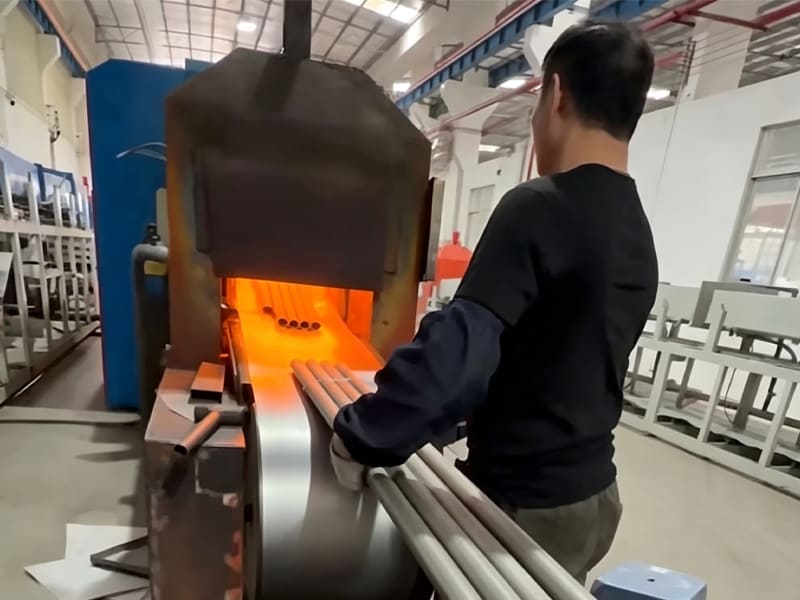
The fourth step is post-weld heat treatment. For cylinders with 25 MPa and above working pressure, heavy-duty or marine service, we always do heat treatment after welding the cylinder barrel. This removes welding-induced internal stress and prevents distortion in later honing and turning work.
We do stress-relief annealing at 620 to 650 ℃, and we set the heating rate no higher than 50 ℃ per hour. The hold time is one hour for every 25 mm of wall thickness, with a minimum of one hour.
For 15CrMo steel, we use 680 to 720 ℃ for annealing. After the holding period ends, we keep the cooling rate under 30 ℃ per hour. This prevents big temperature differences between the barrel’s inner and outer walls. Such big differences would create new internal stress and cause distortion or cracks.
Finally, we let the barrel cool in the furnace until its temperature drops below 300 ℃, then take it out for air cooling.
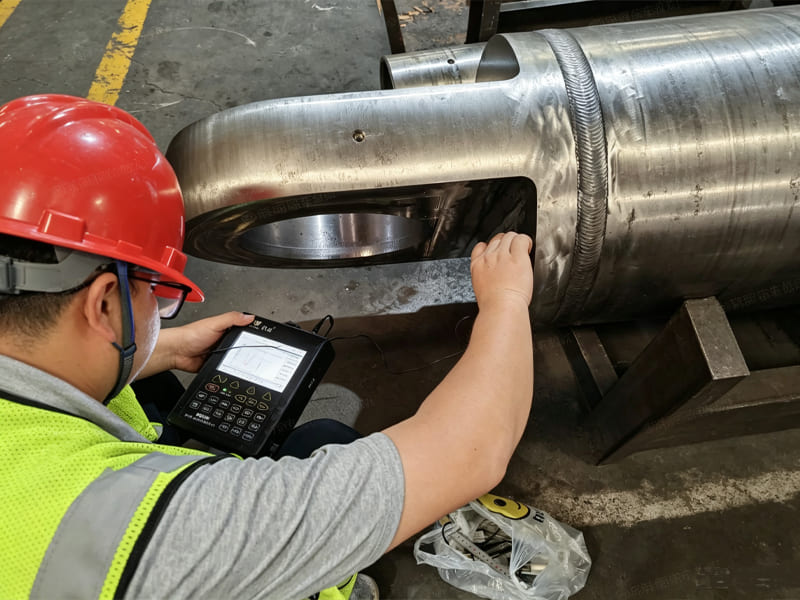
5. Weld Non-Destructive Testing
After welding, we do non-destructive testing on welds to check for cracks on the surface and inside. For welds on ferromagnetic steel, we use magnetic particle testing. It uses magnetic force to find tiny surface cracks. For non-ferromagnetic materials, we use penetrant testing. The penetrant liquid helps show small surface cracks. Besides, we use ultrasonic testing to find hidden defects deep inside the weld and check subsurface issues.
We do 100% ultrasonic testing on the circumferential welds between cylinder barrels and cylinder bottoms. They must meet Class II or higher. All critical fillet welds get 100% magnetic particle testing and must reach Class I. Class I and Class II are weld quality grades. Class I has tighter defect limits and higher standards. If you specify Class I welds, we will inspect them to Class I requirements.
Also, we do ultrasonic testing 24 hours after welding. This ensures we don’t miss any delayed cracks that develop after welding.
Leveraging our full in‑house manufacturing capacity, we are ready to develop custom hydraulic cylinder solutions for your project. Please get in touch with us today.
Contact Us